← STORIES · GUIDES · 8 MIN
The Neuroscience of Wayfinding: How Our Brains Navigate Events
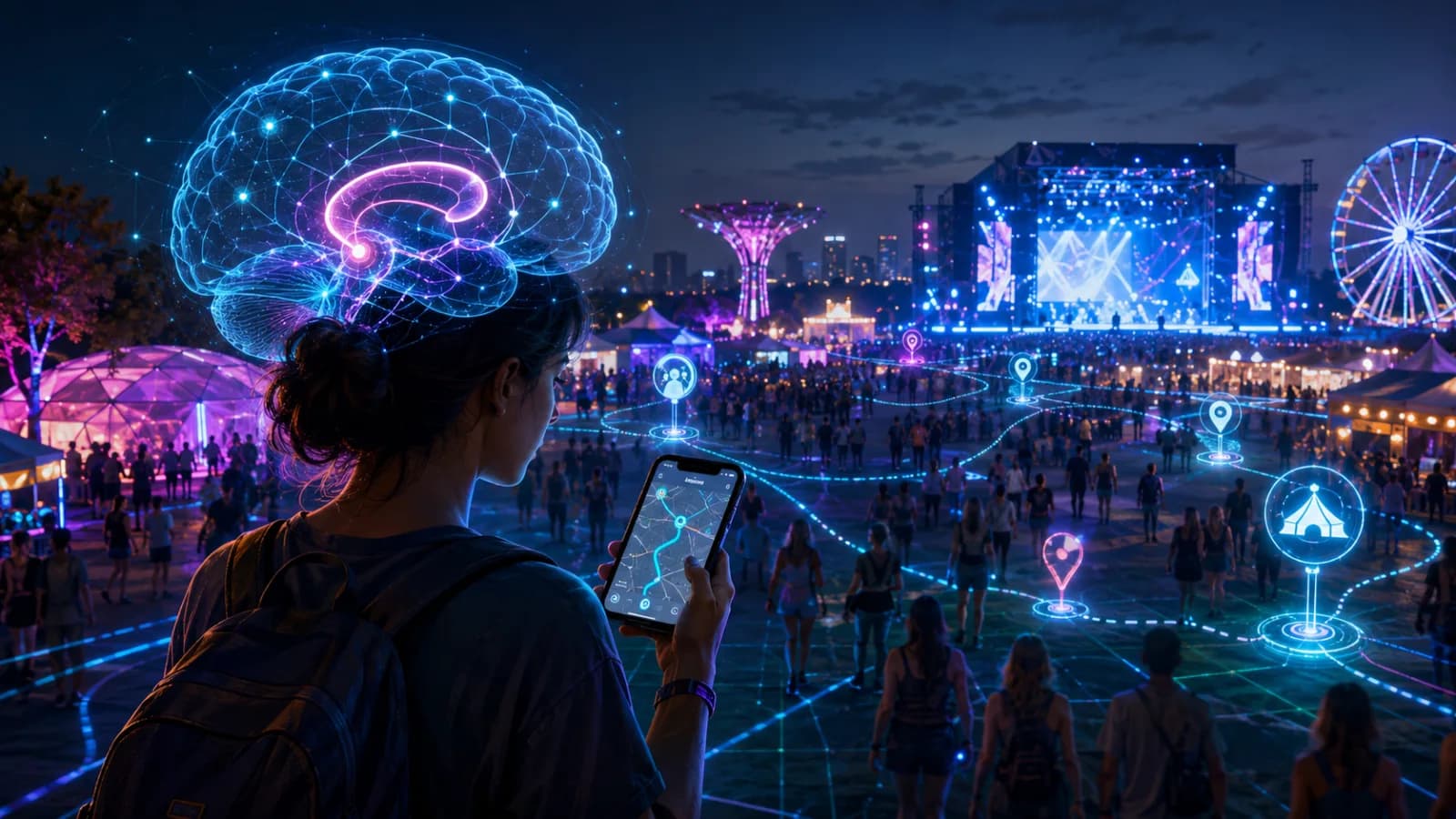
Have you ever wondered why finding your way through a crowded festival can feel so mentally exhausting? Or why some venues seem intuitively easy to navigate while others leave you disoriented? The answers lie in the fascinating intersection of neuroscience, cognitive psychology, and spatial design. At FindTribe, we've been deeply invested in understanding these principles—not just as academic curiosities, but as the foundation for building technology that works in harmony with your brain's natural navigation systems.
The Hippocampus: Your Inner GPS
Deep within your brain's temporal lobe lies a seahorse-shaped structure called the hippocampus—arguably the most important neural region for spatial navigation. In 2014, neuroscientists May-Britt and Edvard Moser, along with John O'Keefe, won the Nobel Prize for their discovery of specialized cells within this region that form what amounts to a biological GPS system.
Place cells and grid cells are key parts of the brain's spatial representation system. Other signals contribute information about direction and boundaries. Together, they help the brain represent where it is in an environment.
What's particularly fascinating is how this system adapts to different environments. In familiar spaces, your hippocampus can rely on established neural maps, making navigation effortless. But in novel environments like your first visit to a music festival, these maps must be created in real-time—a process that demands significant cognitive resources and explains why navigating new spaces feels mentally taxing.
Cognitive Maps: More Than Just Geography
In the 1940s, psychologist Edward Tolman proposed the revolutionary idea that animals (including humans) develop "cognitive maps"—mental representations of spatial environments that go beyond simple stimulus-response associations. Modern neuroscience has not only confirmed Tolman's theory but expanded our understanding of these maps' complexity.
Your cognitive map of an event space isn't just a mental picture of its layout—it's a rich, multidimensional representation that integrates visual landmarks, sounds, smells, emotional associations, and even social information. This explains why you might remember a stage location not by its coordinates but by "the place with the amazing light installation" or "where we saw that incredible sunset set."
Landmark-Based Navigation
Landmarks are a well-established part of human wayfinding. Event maps can support that behavior by emphasizing distinctive stages, entrances and installations rather than presenting coordinates alone.
Perhaps most interesting is how these cognitive maps become socially shared. When you and your friends attend an event together, your individual cognitive maps gradually align through conversation and shared experiences. Phrases like "Let's meet by the big art installation" work because you've collectively integrated that landmark into your shared spatial understanding.
Cognitive Load and Navigational Stress
One of the most important concepts for understanding navigation challenges is cognitive load—the amount of working memory resources being used at any given time. Your brain has limited processing capacity, and wayfinding in complex environments can consume a significant portion of these resources.
Navigating an unfamiliar environment draws on attention, working memory and decision-making as well as spatial processing. That combination helps explain why finding a route through a new venue can feel mentally tiring.
Cognitive Offloading
"Cognitive offloading" means using an external tool to reduce what must be remembered or calculated mentally. A saved schedule, map and meeting point are everyday examples. FindTribe brings those aids together so less of the plan has to live in your head.
Environmental Psychology and Wayfinding Design
The field of environmental psychology has revealed fascinating insights about how physical spaces influence our navigation strategies. Research shows that humans instinctively categorize spaces hierarchically—we think in terms of regions, sub-regions, and specific locations, rather than processing every detail simultaneously.
Well-designed event spaces leverage this natural tendency by creating clear visual boundaries between areas and establishing distinctive character for different zones. This is why the best festivals often have themed areas with unique visual identities—they're not just aesthetically pleasing, they're actually working with your brain's natural spatial processing systems.
FindTribe uses visual hierarchy, color and recognizable map features to help people scan a venue. Whether a particular design performs better should be established through usability testing rather than assumed from a general research finding.
Social Navigation and Collective Intelligence
Humans are inherently social navigators. Anthropological research reveals that throughout history, humans have relied on collective intelligence for spatial navigation—sharing information about routes, landmarks, and potential hazards. This social dimension of wayfinding remains powerful even in our GPS-enabled world.
A place often becomes easier to remember when it carries social meaning: "the gate where we met" is more useful than an anonymous coordinate.
The Social Navigation Network
Showing an opted-in friend's location adds practical social context to a map. FindTribe has not measured whether that feature changes a user's spatial memory or brain activity.
Augmented Cognition: How Technology Extends Natural Capabilities
The emerging field of augmented cognition explores how technology can extend and enhance human cognitive abilities rather than replacing them. This approach has been particularly fruitful in the domain of spatial navigation, where well-designed tools can work in harmony with our natural neural systems.
A useful navigation tool should support orientation without demanding constant attention. How much guidance is helpful varies by person, task and environment.
Multimodal Augmentation
Visual, haptic and audio cues can serve different users and situations, supported by thoughtful accessibility testing and controls. FindTribe currently emphasizes map orientation, venue features and social context.
Individual Differences in Spatial Cognition
One of the most important discoveries in spatial cognition research is the remarkable variation in how different people navigate. Some individuals rely heavily on a "mental compass" approach, maintaining awareness of cardinal directions. Others use a route-based strategy, memorizing sequences of turns. Still others navigate primarily by landmarks.
People vary in their experience, abilities and preferred navigation strategies. That diversity creates a design challenge: maps should offer more than one kind of cue and should be tested with the people expected to use them.
The Future: Personalized Cognitive Assistance
As our understanding of spatial cognition deepens and technology becomes more sophisticated, we're moving toward a future of personalized cognitive assistance for navigation. Machine learning algorithms can already detect individual navigation preferences and adapt accordingly, but the next frontier is even more exciting.
Emerging research in cognitive neuroscience is exploring how real-time physiological signals—eye movements, stress indicators, even subtle changes in walking patterns—can reveal when someone is experiencing wayfinding difficulty before they're consciously aware of it. This opens the possibility of preemptive navigation support that activates precisely when needed.
Personalized cognitive assistance is a research direction, not a current FindTribe capability. Our product goal is more modest: make event maps and coordination clearer without demanding more attention than the event itself.
Adaptive Interfaces
A future adaptive interface might vary the amount of guidance with context. FindTribe is not currently measuring a user's cognitive state.
Navigation as Experience Enhancement
The science of wayfinding reveals something profound: navigation isn't just a practical necessity—it's an integral part of how we experience environments. When navigation is effortless, it frees cognitive resources for deeper engagement with performances, stronger social connections, and more vivid memory formation.
By designing technology that works in harmony with our brains' natural navigation systems, we can transform wayfinding from a potential source of stress into an enabler of richer experiences. This is the philosophy that guides FindTribe's approach to spatial technology—not just helping you find your way, but enhancing how you experience the journey.