← STORIES · GUIDES · 6 MIN
Navigating Music Festivals Like a Pro
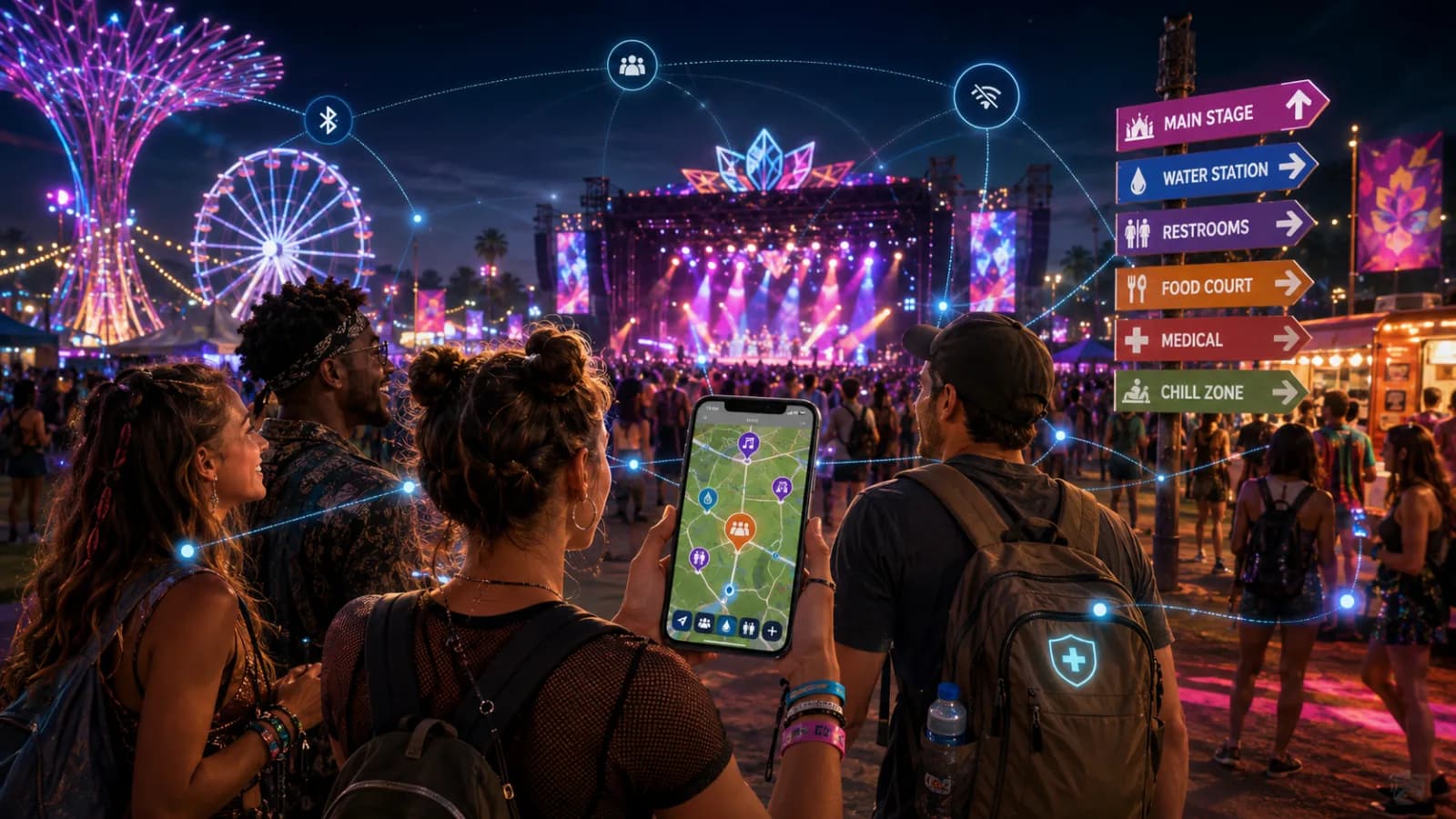
What makes the difference between a good festival experience and a transcendent one? It is not just the lineup. A little preparation can reduce the number of decisions you have to make in an unfamiliar, crowded place and leave more attention for the event itself.
The Psychology of Pre-Event Planning
Cognitive load theory helps explain why pre-planning is useful: working memory is limited, and repeatedly deciding which act to see, where to eat and how to get there can become tiring.
Pick a few must-see moments, leave room between them, and agree on a meeting point before the crowd gets loud.
This is a practical form of “satisficing”: setting reasonable priorities instead of trying to optimize every minute or see every performance.
Spatial Cognition and Environmental Psychology
The science of wayfinding helps explain why festival grounds can feel disorienting. People build “cognitive maps” of unfamiliar spaces over time, using paths, boundaries and recognizable landmarks.
A digital venue map can help by making those landmarks and routes available before you have learned the grounds yourself.
Anchor Points and Cognitive Mapping
Research in spatial cognition shows that humans navigate using "anchor points"—memorable landmarks that serve as reference points. FindTribe's meeting point feature was designed based on this research, allowing groups to establish shared mental anchors that reduce cognitive load.
The Neuroscience of Social Connection at Events
Being separated from friends in an unfamiliar crowd is stressful; reuniting is a relief. A shared meeting point and opt-in friend location can reduce the coordination burden without replacing the social experience.
Collective Effervescence
Sociologist Émile Durkheim used “collective effervescence” to describe the heightened energy people can feel when a group gathers around a shared experience.
The Technology Behind Festival Connectivity
The technical challenge of providing connectivity to tens of thousands of people in a confined area is fascinating from an engineering perspective. Traditional cellular networks are designed for distributed usage patterns, not the concentrated demand of festivals. This is where Cell-on-Wheels (COWs) technology becomes critical.
Temporary cells and distributed antenna systems can add capacity, but the experience still depends on the carrier, venue deployment, spectrum and the number of people trying to connect at once.
Extra network capacity helps, but attendees should still download essential maps and schedules before entering the venue.
FindTribe downloads venue information in advance and uses its Bluetooth mesh for supported offline functions when carrier data is unavailable.
The most cutting-edge festivals are now implementing distributed antenna systems (DAS) that create microcells throughout the venue. These systems not only improve connectivity but also reduce battery drain on attendees' devices—a critical factor in multi-day events where charging opportunities may be limited.
Chronobiology and Festival Timing
Energy and alertness change over a long event, but the pattern differs by person, sleep, heat, food and many other factors. Build breaks, water and food into your own schedule instead of relying on a universal “best” hour.
The Physiology of Festival Endurance
Festivals can mean many hours of standing, walking and dancing, often in heat. Comfortable footwear, water, food and planned breaks matter.
Follow the event’s safety guidance, use marked water stations and seek on-site medical help when you need it.
This research explains why proper hydration and nutrition aren't just health concerns—they directly impact your ability to navigate, make decisions, and fully enjoy performances. FindTribe's water station markers were developed in response to this research, making it easier to maintain optimal hydration throughout the event.
Crisis Psychology and Emergency Response
Before the event, identify exits, medical points and the organizer’s emergency instructions. A phone feature is not a substitute for venue staff or emergency services.
This isn't about anxiety or expecting problems—it's about creating what psychologists call "response readiness" that actually allows for greater relaxation and enjoyment. When you know you can handle unexpected situations, you can be more fully present in the moment.
FindTribe puts SOS two taps away and sends it to your FindTribe friends over the internet and Bluetooth mesh. It does not contact venue staff or emergency services.
The Science of Serendipity
Perhaps counterintuitively, research in experience design shows that planned spontaneity often creates the most memorable moments. Psychologists call this the "serendipity paradox"—the phenomenon where leaving deliberate space for unexpected experiences actually increases their likelihood and impact.
This explains why the most satisfied festival attendees often report a balance of planned and unplanned experiences. By creating a flexible framework rather than a rigid schedule, you create the conditions for what psychologists call "positive spontaneity"—unexpected discoveries that feel both surprising and meaningful.
At FindTribe, we've incorporated this research into our recommendation algorithm, which suggests nearby experiences based on your preferences while still prioritizing serendipitous discovery—what data scientists call the "exploration-exploitation balance."
The Science of Festival Flow
When all these elements come together—thoughtful planning, effective navigation, group connection, physical wellbeing, and openness to serendipity—you create the conditions for what psychologist Mihaly Csikszentmihalyi famously called "flow state." This optimal psychological state, characterized by complete immersion and enjoyment, is the holy grail of festival experiences.
FindTribe was designed with this science in mind—not just as a practical tool, but as a way to reduce cognitive friction so you can more easily access these transcendent states of enjoyment and connection. By handling the logistical cognitive load, we free your mental resources for what really matters: the music, the moments, and the memories.