← STORIES · GUIDES · 4 MIN
Creating Accessible Events for Everyone
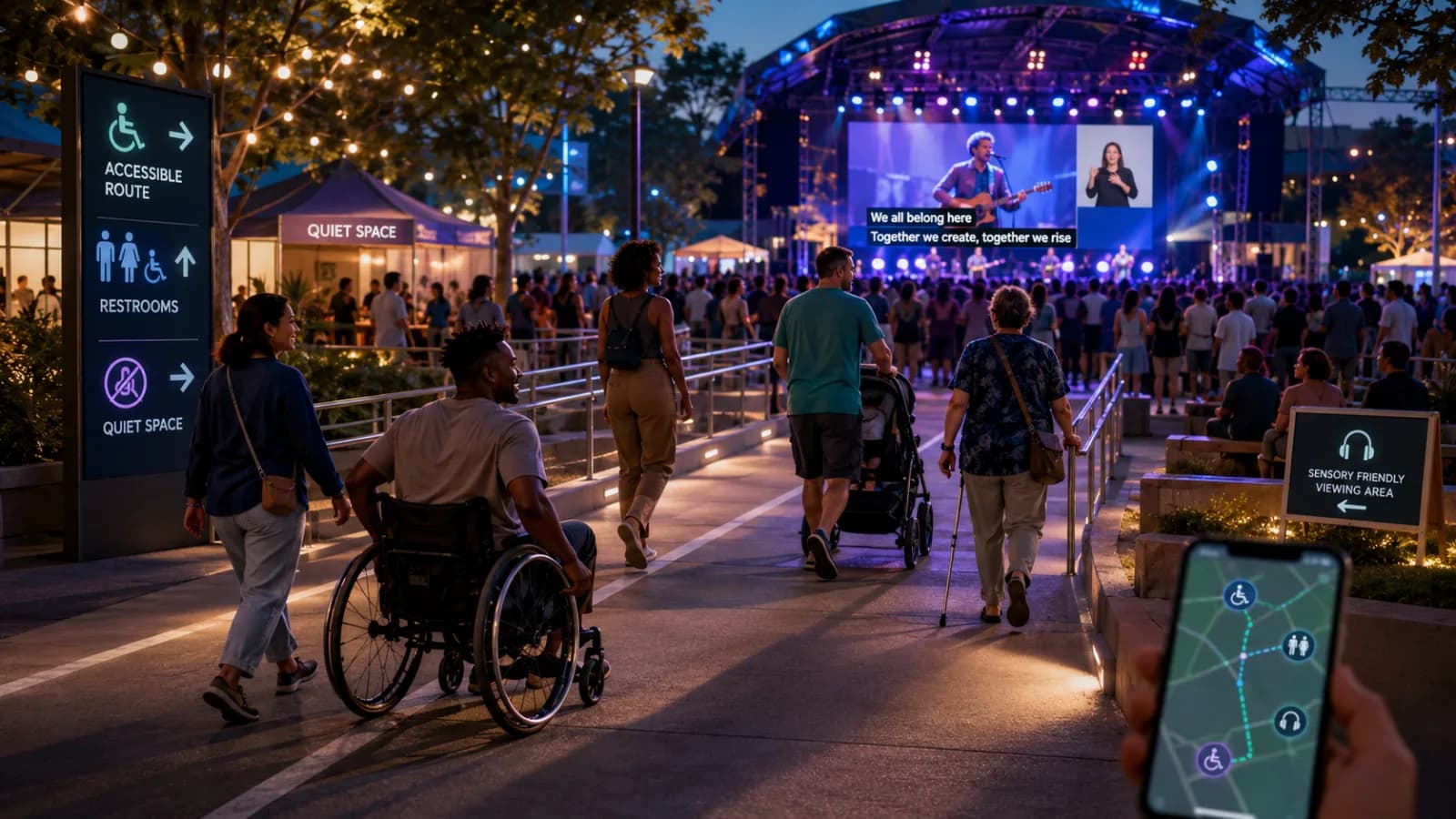
What if the most memorable events were designed so more people could participate fully? Accessibility is both a civil-rights responsibility and a practical design discipline. Many improvements—clear signs, step-free routes, captions and quiet spaces—also help people whose needs change with the environment.
Why Accessibility Matters: The Science of Inclusion
According to the World Health Organization, an estimated 1.3 billion people—about 16% of the global population—experience significant disability. Accessible events remove barriers to participation for a substantial part of every community.
Accessibility works best when it is planned with disabled attendees, communicated clearly and tested before the gates open.
The “curb-cut effect” describes how features designed to remove disability barriers can benefit many other people: ramps also help parents with strollers, travelers with luggage and delivery workers.
The Neuroscience of Physical Navigation
Spatial Cognition and Venue Design
Step-free access, clear pathways, resting points and accurate accessibility information reduce uncertainty and make a venue easier to navigate.
The Restroom Revolution
Accessible restrooms should be available in sufficient numbers, placed on usable routes and kept clear. A map should identify them accurately instead of treating every restroom marker as equivalent.
Visual Processing and Signage
High-contrast signage, legible type, plain language and consistent icons can help people with low vision, cognitive disabilities and visitors navigating a language barrier.
The Transportation Gap
Accessible transport information must cover the whole journey: arrival, drop-off, parking, shuttles, entrances and the route back out.
The Sensory Experience Revolution
Crowds, sound, lighting and queues can create sensory barriers. Publish what attendees should expect and offer practical alternatives where possible.
The Science of Quiet Spaces
Designated quiet areas give attendees a place to step away from high stimulation. They should be clearly marked, genuinely quieter and reachable by an accessible route.
Multi-Modal Information Processing
Important information should not depend on one sense alone. Pair announcements with text, use icons with labels, and provide captions and transcripts where applicable.
The Language of Inclusion
Sign-language interpretation and high-quality captions give Deaf and hard-of-hearing attendees access to content that audio alone cannot provide.
Digital Accessibility: FindTribe's Research-Driven Approach
At FindTribe, we've invested in understanding how digital tools can enhance accessibility rather than create new barriers. The inclusive-design field has shaped our development philosophy in profound ways.
Cognitive Mapping and Navigation
Pre-planning a route can reduce uncertainty. FindTribe caches schedules and meet points before arrival so they remain available offline.
Multi-Sensory Notification Design
Notifications should use more than color or sound alone and should respect device accessibility settings.
Dynamic Typography
Interfaces should support the platform's text-size settings and remain usable when text is enlarged.
The Human Element: Communication and Training
Physical access is not enough. Staff need role-specific training, clear escalation paths and accurate information about the accommodations the event actually provides.
This highlights what social psychologists call "the interaction model of disability"—the recognition that disability isn't inherent in the individual but emerges from the interaction between people and their environment, including social interactions. When staff understand this model, they naturally avoid patronizing behaviors and focus on removing barriers rather than "helping the disabled."
The Feedback Loop: Continuous Improvement Through Data
Accessibility is not a one-time checklist. Invite feedback from disabled attendees, track specific barriers and publish what changed before the next event.
This aligns with what organizational psychologists call "inclusion maturity models"—frameworks that show how organizations evolve from basic compliance to proactive inclusion to eventually transformative approaches where diverse needs drive innovation rather than just accommodation.
The Future of Accessible Experiences
The most exciting frontier in accessibility research is the concept of "universal experience design"—where accessibility considerations actually drive innovation that benefits everyone. From voice interfaces originally designed for blind users but now ubiquitous in smart homes to captioning technology that's become essential for social media video, we're seeing how designing for the edges improves the core experience.
At FindTribe, inclusive design is ongoing product work. Formal accessibility testing and direct feedback from disabled people will guide the next improvements.