/FINDTRIBE MESH — INTERNET · DIRECT LORA · BLUETOOTH
One send.
More than one way through.
FindTribe Mesh is the app's offline layer: direct LoRa links between compatible pods for range, and nearby phones relaying sealed messages over Bluetooth up close. The app tries the internet first, then Mesh. Phase 1 ships direct pods with no repeaters. Repeaters come next.
Internet
UNAVAILABLE
Long-range pods
SENDING NOW
Nearby phones
BLUETOOTH · DEVICE TO DEVICE
The message travels directly from pod to pod.
When the internet is down, two compatible pods can send the message directly over long-range LoRa radio. No cell tower or repeater is needed.
MESSAGE PATH · LONG-RANGE RADIO PODSPhase 1 · Direct pod to pod
LoRa means
long range.
LoRa is a low-power radio technology built to move small amounts of data much farther than Bluetooth, without a cell tower or Wi-Fi. A phone does not contain the LoRa radio FindTribe uses, so it pairs over Bluetooth with a small companion pod. Phase 1 connects two pods directly for short texts, SOS, and location updates. In favorable open conditions, direct reach can be a few miles; buildings, terrain, antennas, interference, and regional radio settings can shorten or extend it.
Two pods. One direct LoRa link.
Each phone pairs with a compatible MeshCore pod. When the two pods are within radio reach, they exchange short, encrypted FindTribe updates directly. In favorable open conditions, that can mean a few miles—but terrain, buildings, antennas, and interference change the real range.
PHONE · POD → DIRECT LORA → POD · PHONEFindTribe builds on the open-source MeshCore system for its LoRa foundation. MeshCore carries the radio packets; FindTribe keeps ownership of identity, end-to-end encryption, receipts, and honest delivery status.
The local fallback · Bluetooth mesh
When the pods cannot reach,
nearby phones can help.
Bluetooth is already inside every phone. Nearby participating FindTribe devices can relay encrypted messages one link at a time through a crowd. Delivery still needs a continuous route. Drag someone below to see that local path break and rebuild.
Proof on the lock screen
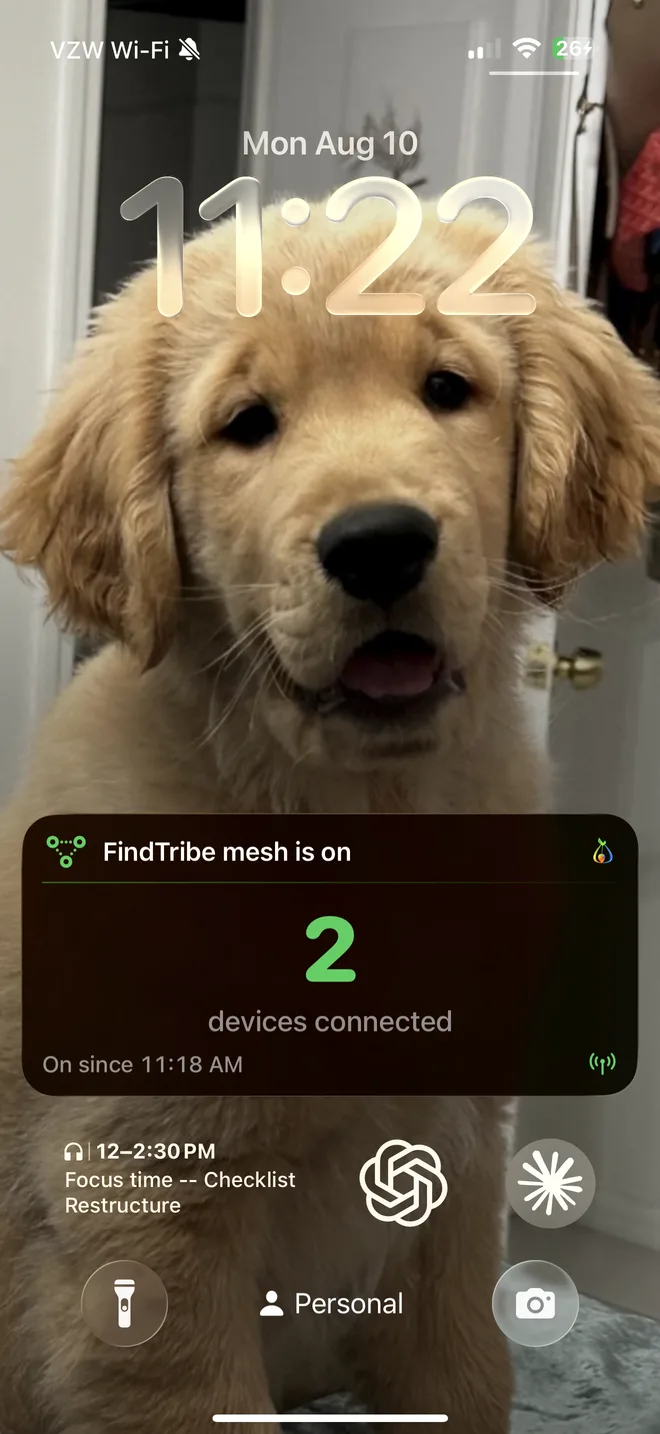
You can watch it work.
The mesh isn't a promise buried in settings — it's a live card on your lock screen: how many FindTribe devices are connected around you, and how many sealed messages you're carrying for other people. Real numbers, updating as the crowd moves.
The protocol
How a message crosses the crowd.
Phones find each other
Any nearby FindTribe phone with Mesh on can become a Bluetooth relay. No pairing. No internet.
Nearby phones carry it farther
Participating FindTribe phones relay the encrypted message one Bluetooth link at a time until it reaches your tribe or the route ends.
Private means private
On the mesh, every DM is sealed before it leaves your hand. A dozen strangers may carry it — none can read a word, and none can tell who sent it or who it's for. All their phones ever show is a count: "Carrying 2 sealed messages for others." Only your tribe holds the keys.
The mesh can try another route
People move and phones leave. If one Bluetooth route breaks, FindTribe can try another through participating phones nearby. It never marks the message delivered until the receiving phone acknowledges it.
Under the hood
What it’s made of.
Three that work. One pairs out of the box.
Three MeshCore pods work with FindTribe. The Wio Tracker L1 Pro pairs the moment it is charged. The SenseCAP T1000-E and RAK WisMesh Tag cost less and need one five-minute setup step on a computer.
Internet, direct LoRa, or Bluetooth. Send once.
FindTribe prefers the internet, can use a direct pod-to-pod LoRa link when it is unavailable, and keeps nearby Bluetooth relays as the local fallback. If no path can reach, the update waits.
Two nearby phones can connect directly. Every additional participating phone within reach can create another possible hop, helping sealed updates travel farther across the crowd. Delivery still needs an unbroken route.
Traded the day you met
FindTribe establishes the encryption keys when you become friends online, so relay devices can later carry packets without being able to read them.
One press looks for a way through.
An SOS can use internet, direct LoRa, or nearby Bluetooth relays when those paths are available. It does not contact police, fire, medical services or satellite responders. Call local emergency services whenever you can. The iPhone card counts friends who acknowledged it, not attempts sent.
A nearby connection can publish it
Post with zero bars and the crowd passes it phone to phone. The first phone that finds internet publishes it for everyone. Nearby phones keep a post moving for 12 hours; the board itself keeps it for a month.
Cached before the gates
Venue maps, set times, meet points and your tribe's trails are stored on-device on your way in.
Bluetooth Low Energy is built to sip power. Real use depends on your phone, location settings and screen time.
Bluetooth stays on
The app needs Bluetooth permission. If airplane mode switches Bluetooth off, turn Bluetooth back on.
No path? It waits.
If nobody in the chain is reachable, a sealed update waits until a phone finds a path.
Know when it arrives
Queued, carried and delivered are different states. The status changes to “Delivered” only when your friend's phone acknowledges the message.
The radio foundation
The foundation had
to fit the product.
FindTribe has a particular shape: personal pods that pair cleanly with the app now, then an intentionally placed repeater backbone later. MeshCore, an open-source LoRa mesh, matches that shape.
Stock pods work with the app
MeshCore publishes a compact companion protocol for controlling a pod over Bluetooth. That lets phase 1 use compatible stock hardware without waiting for custom FindTribe firmware.
Clients stay quiet. Repeaters do the repeating.
MeshCore separates personal companion pods from dedicated repeaters. That maps cleanly to our rollout: direct pod-to-pod links first, carefully placed infrastructure in phase 2.
The pod carries sealed packets
FindTribe keeps friend identity, encryption keys, replay protection, receipts, and delivery truth in the app. The pod is a carrier—not a place where your private conversation is opened.
Small, documented, and MIT-licensed
MeshCore's documented wire format and permissive core give FindTribe room to integrate the system responsibly while continuing to contribute to—and credit—the open-source foundation we rely on.
Phase 1 uses MeshCore as a carrier for private FindTribe traffic. It does not make you visible in public MeshCore chats or announce your FindTribe identity to nearby MeshCore users.
DIRECT PODS FIRST · REPEATER NETWORK NEXT
One failed connection
shouldn’t keep you apart.
Learn the limits, pair before you need it, and let FindTribe look for the path that is still alive.