← STORIES · TECHNOLOGY · 6 MIN
Voice AI and Crowd Intelligence: What Your Festival App Can Do Tonight, and What's Coming
You didn’t come to the festival to read a map. You came for goosebumps.
So the useful question isn’t what an event app might do in 2030. It’s what it can do at 11PM tonight, with 80,000 people around you and one bar of signal that’s about to become zero. Here’s the split: what FindTribe does tonight, what attendees have reported for the selected event, and what the industry is still building toward.
Tonight: ask out loud, read the answer
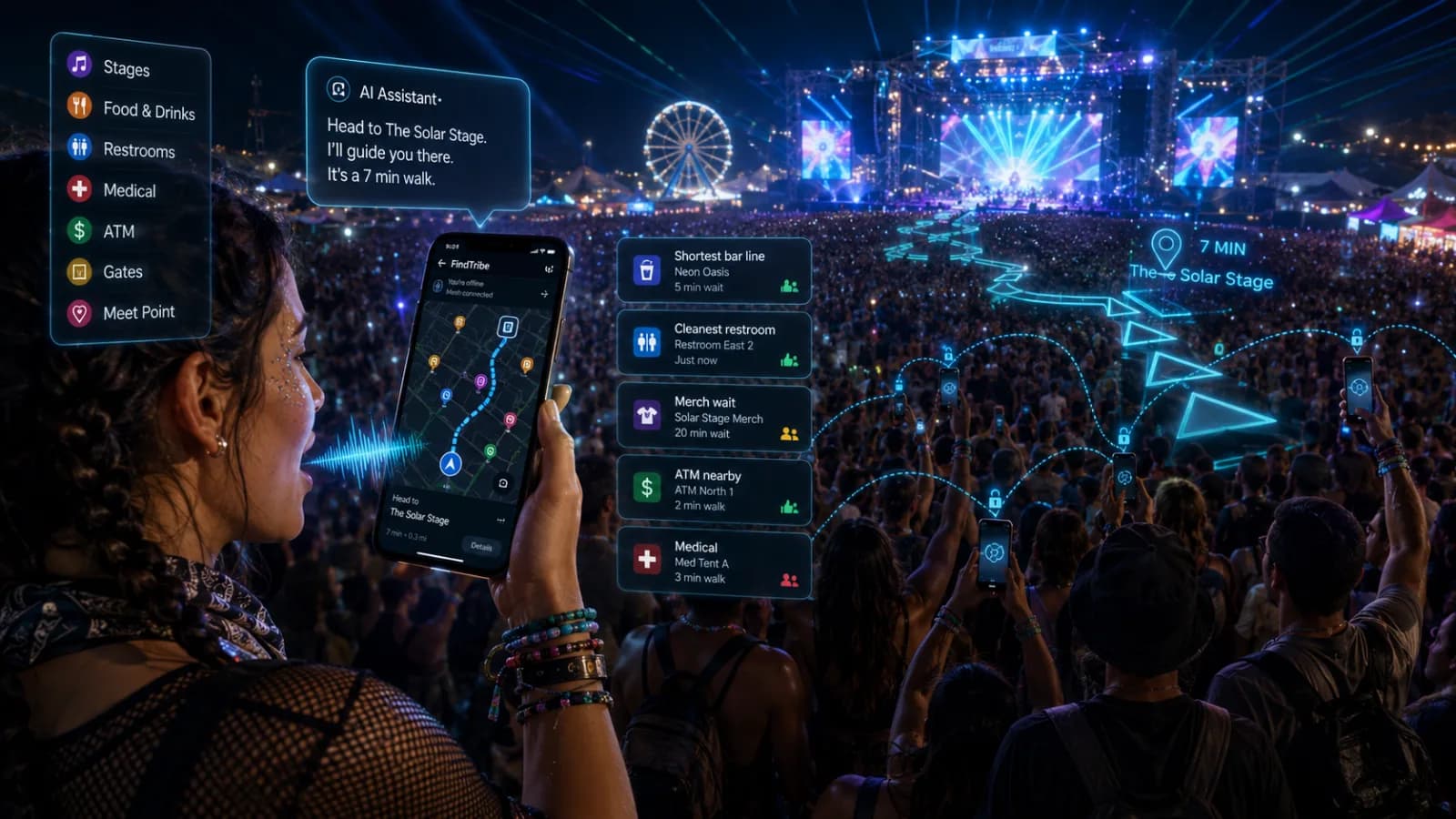
Hands full. Eyes up. Music loud enough that typing is a joke. So you say it — “when does she play?”, “which entrance has the shortest reported line?”, “what’s that vendor serving?” — and FindTribe writes the answer back. Speak it or type it; either way the reply is text.
The assistant checks the selected event’s map and schedule for stages, set times, artists, vendors, restrooms, medical stations, ATMs and gates. Tap a mapped result to start walking directions.
If the selected event has no matching result, the assistant says so.
Tonight: what attendees have reported
Here’s the part people underestimate. You don’t need a venue wired with cameras to know which bar is quick. You need the person who just walked away from it.
FindTribe attendees can report what they see — line lengths at bars, entrances and merch; whether a restroom is in good shape; and how they rate a food vendor. The assistant can compare the reports available for the selected event and return mapped choices.
Line lengths and ratings come from attendees, not venue sensors. They reflect what people have shared, and conditions can change.
Tonight: the path that does not need carrier data
At a packed event, carrier data can stall under concentrated demand. Messages queue and a live-location map may stop updating.
FindTribe was built for the minute after that. The venue map downloads to your phone when you activate the event, so stages, gates, water and restrooms are already on the device. Your schedule and your meet points come with them.
FindTribe can use nearby participating phones as Bluetooth relays. Sealed location updates and DMs move one link at a time until they reach your tribe or the route ends. Relay phones cannot read the message. If no route exists yet, a participating phone may hold the sealed packet until a usable path appears.
Drop a meet point and everyone gets the same destination, bearing and distance. Raise an SOS and FindTribe alerts the trusted people you selected over internet and Bluetooth at the same time. SOS does not contact emergency services.
The assistant needs an internet connection. Cached maps, schedules, meet points and compass guidance stay on the phone; messages can use a reachable internet or Bluetooth path.
Next: when a venue can feel itself
Now the future: what becomes possible when a venue can understand movement across the field.
The prize is density. Not “where are the stages” but “where are the people right now, and where will they be in five minutes.” Solve that and routing changes completely: ask for the main stage and the path bends around the crush instead of through it. A corridor clogs and your route pivots before you’ve noticed. A set ends and you’re moved out ahead of the wave rather than inside it.
None of that is a small step from here. It needs opt-in sensing at real scale, built to read the texture of foot traffic and never the identities inside it — a pool of movement, not a list of people. Build it wrong and you’ve made a surveillance system with a friendly icon.
What density would unlock
- Constraint routing. “Least crowded.” “Fewer stairs.” “Meet halfway without crossing the flow.” Plain language becoming a constraint the route actually respects.
- Timing, not just place. Lines breathe. Knowing when the dip is coming is worth more than knowing where the queue is.
- Accessibility-aware routing. Ramps, lighting and low-slope paths on request — a bar the whole industry still has to clear.
- Dispersal before it’s dangerous. Routes that open before density becomes a crush. This is what the industry owes the people in the crowd, and nobody ships it yet.
Next: arrows painted on the night
Today the best heads-up display is a phone you glance at. Tomorrow it’s glass: an arrow laid onto the path in front of you, a halo around the spot where you’re meant to meet, your friend picked out of a crowd of thousands without you lifting a hand.
That is genuinely coming, and it will feel like magic the first time. It is also not the thing that saves your night this weekend.
Why the unglamorous part matters most
Our brains run on landmarks and stories, not coordinates. Decades of wayfinding research land in the same place: people navigate by “past the food stalls, then left at the sound tower”, not by a grid reference.
Which is why the practical layer decides how your night actually goes: a map already on your phone, a meet point everyone agreed on, and a message that can use internet or nearby Bluetooth. The clever future is worth building; the tools already in your hand are what get you back to your people tonight.
Get lost in the moment, not the crowd
Tell FindTribe where you’re headed. Ask it out loud while connected. Drop a pin your friends can walk to. If carrier data fails, cached guidance stays on the phone and supported messages can try a reachable Bluetooth path.
The arrows painted on the world may come later. The practical tools are here tonight.