← STORIES · TECHNOLOGY · 9 MIN
Augmented Reality: The Future of Event Navigation and Experiences
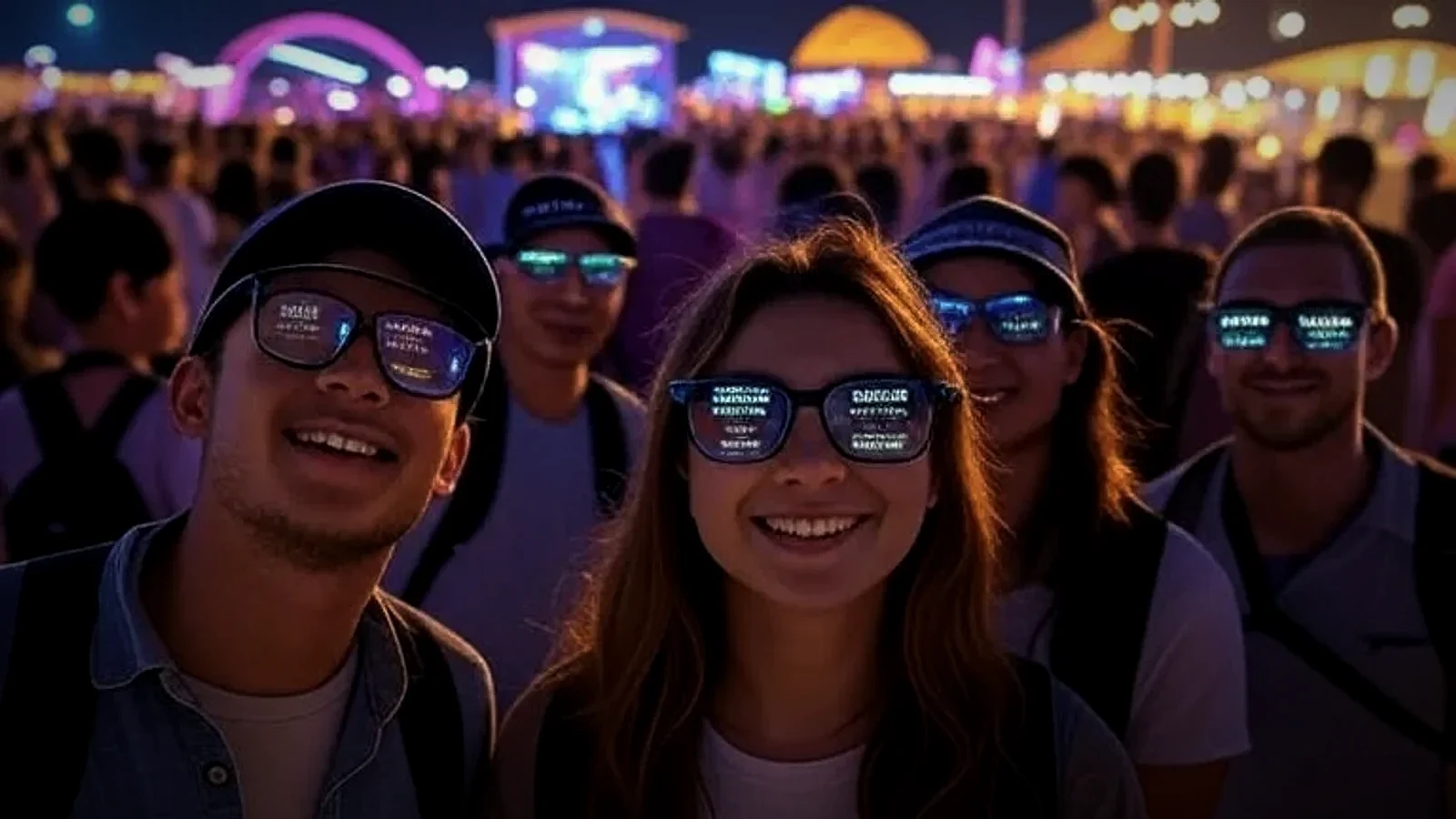
Imagine arriving at a massive festival and instantly seeing a personalized path illuminated before you, guiding you effortlessly to your friends while highlighting points of interest along the way. Building on the intuitive navigation that FindTribe already provides, this next evolution in technology could further enhance how we experience events. This isn't science fiction. It's the next few years of augmented reality (AR) technology, and it represents the next frontier in event navigation and social experiences.
The AR Revolution: Beyond Smartphone Screens
For years, augmented reality has been confined primarily to our smartphone screens—think Pokémon GO or simple face filters. But we're now witnessing a pivotal shift as AR moves toward wearable devices that could blend more seamlessly into our everyday lives. The latest generation of AR-capable eyewear from companies like Meta represents early steps in this direction, with more advanced systems in development.
Some smart glasses now resemble ordinary eyewear, but most consumer models are not full augmented-reality displays. Meta's collaboration with Ray-Ban is evidence of interest in wearable cameras, audio and assistants; it should not be confused with a shipping, heads-up AR navigation platform.
What makes these emerging technologies potentially revolutionary is their ability to layer digital information directly onto our view of the physical world without requiring us to look down at a screen. This hands-free, heads-up experience represents a fundamental shift in how we might interact with digital information—one that could be particularly valuable in dynamic, crowded environments like festivals, conferences, and sporting events.
The Cognitive Science of Navigation
To understand why AR navigation represents such a potential breakthrough for events, we need to examine how humans naturally navigate spaces. Traditional static paper maps force users to constantly switch contexts—looking down at a map, then up at surroundings, then back down again. This creates what cognitive scientists call a high "cognitive load," requiring our brains to constantly translate between 2D representations and 3D reality.
Switching repeatedly between a map and the surrounding environment adds mental work. FindTribe's current approach provides a dynamic, GPS-based map rather than a static diagram. A future AR interface could take this further by overlaying directional cues onto the real world, but that capability is exploratory rather than a current FindTribe feature.
The Cognitive Advantage
Early research into AR navigation suggests it could significantly reduce the mental effort required for wayfinding compared to traditional paper maps. FindTribe's current dynamic navigation system already offers many of these cognitive benefits by providing real-time, personalized guidance that updates as you move.
These cognitive advantages become even more pronounced in complex, unfamiliar environments like festival grounds or convention centers—precisely the types of spaces where FindTribe's intuitive navigation system currently shines, and where future AR integration could offer additional enhancements.
AI-Powered Contextual Awareness
The latest AR systems aren't just displaying static information—they're becoming increasingly intelligent thanks to integration with sophisticated AI systems. These AI assistants can understand context, anticipate needs, and provide information that's relevant to your specific situation and preferences.
For example, Meta's AI assistant can now recognize what you're looking at and provide relevant information about it. Point your glasses at a stage schedule, and the AI might offer to set reminders for performances you've expressed interest in. Look at a food vendor, and it could tell you the wait time or popular menu items based on real-time data.
"The integration of multimodal AI with AR glasses creates a system that doesn't just see what you see—it understands what you're looking at and why it might matter to you in that specific moment."
This contextual awareness represents a fundamental shift in how technology assists us. Rather than requiring explicit commands or searches, these systems can proactively offer relevant information based on environmental cues and personal preferences—a capability that's particularly valuable in information-rich environments like events.
Beyond Navigation: The Social Dimension
While improved navigation is a compelling use case, AR's potential at events extends far beyond simply getting from point A to point B. Perhaps the most exciting applications involve enhancing social connections—the very heart of what makes live events special.
Finding friends in crowded venues has always been a challenge, often involving complex coordination via text messages with vague landmarks as reference points. FindTribe already solves this problem effectively with our real-time friend location features. Future AR glasses with friend-finding capabilities could potentially build on this foundation by displaying the real-time location of your group members directly in your field of view—even in crowds where traditional GPS lacks the necessary precision.
Enhanced Social Coordination
FindTribe's current friend-finding features are designed to reduce coordination time. Future AR integration could potentially bring that information into a user's field of view, but this has not been measured or shipped.
Beyond simply locating friends, these systems could facilitate more meaningful social interactions. Imagine your glasses highlighting people with shared interests at a networking event, or showing which of your friends have already visited a particular art installation at a festival. These capabilities could transform events from potentially overwhelming experiences into richly connected social environments.
Real-Time Crowd Intelligence
One of the most promising applications of AR at events involves using collective data to optimize individual experiences. By aggregating anonymized movement data from multiple users, these systems can develop real-time understanding of crowd dynamics throughout a venue.
Today, FindTribe focuses on mapped venues and private location sharing with trusted friends. Crowd-aware routing is a future direction that would need explicit consent, careful aggregation and validation with crowd-safety professionals.
Dynamic Crowd Management
Advanced navigation systems may help operators understand bottlenecks, but an attendee app must not be presented as a substitute for venue capacity planning, trained staff or an emergency crowd-management plan.
For event organizers, these systems offer unprecedented insights into how attendees move through spaces, which attractions generate the most interest, and where potential problems might develop. This data can inform both immediate operational decisions and long-term planning for future events.
The Hardware Evolution: From Smartphones to Glasses
The current AR landscape is in an interesting transitional phase. While purpose-built AR glasses represent a potential future, smartphone-based AR remains the more accessible and practical option for most users today. This creates a dual-track approach where both modalities need to be supported for the foreseeable future.
However, the hardware landscape is evolving. Meta's Ray-Ban glasses have demonstrated that stylish, consumer-friendly smart eyewear is achievable, though true AR capabilities in comfortable form factors remain a significant technical challenge. Industry analysts project continued growth in this sector, though mass adoption of fully-featured AR glasses is likely still several years away.
"The AR glasses market is projected to grow significantly in the coming years as technology advances, though widespread adoption will depend on solving current challenges in display technology, battery life, and form factor."
This evolving landscape presents both opportunities and challenges for event technology providers like FindTribe as we prepare for a future where multiple interaction models coexist.
FindTribe's Vision: Leading Today While Building for Tomorrow
FindTribe currently provides an interactive map designed for events, avoiding some of the guesswork required by a static venue diagram.
AR navigation is a future concept, not a shipping feature or announced release. The ideas below describe possible directions rather than a product commitment.
Forward-Looking Innovation
As we explore future AR integration, we're investigating how technologies like computer vision and spatial anchoring could eventually enable even more precise friend-finding in crowded environments—building on the strong foundation of our current platform.
We're also exploring how AR could potentially enhance the discovery aspect of events. Imagine looking at a stage and seeing not just who's performing now, but who's coming up next, complete with previews of their music and personalized recommendations based on your listening history. Or glancing at a food vendor and immediately seeing wait times, menu highlights, and dietary information relevant to your preferences.
These capabilities would represent an evolution of the FindTribe experience—moving from the already intuitive active information-seeking of our current app to an even more seamless, contextual information delivery that further enhances rather than distracts from the live experience.
Privacy and Ethical Considerations
As with any technology that combines cameras, location tracking, and AI, AR glasses raise important privacy and ethical questions that must be addressed thoughtfully. The ability to recognize and track individuals in public spaces creates both opportunities and responsibilities.
At FindTribe, we believe that privacy must be built into these systems from the ground up, not added as an afterthought. This means developing clear consent mechanisms, transparent data practices, and robust security measures to protect sensitive information.
"We're developing a privacy-first approach to AR that gives users granular control over what information is shared and when. Our philosophy is that technology should enhance human connection without compromising personal boundaries."
We're also mindful of the potential social implications of AR technology. While these tools could enhance connection, they could also create new forms of digital divide or social pressure. Any future work would need to preserve a useful phone experience for attendees without specialized hardware.
The Road Ahead: What's Next for AR at Events
Looking forward, we see several exciting developments on the horizon for AR technology at events. The integration of haptic feedback systems could add a tactile dimension to AR navigation, allowing users to "feel" directions through subtle vibrations rather than having to visually process them.
We're also watching the development of shared AR experiences—systems that allow multiple users to interact with the same virtual elements simultaneously. These capabilities could enable entirely new forms of collaborative art, interactive performances, and social games that blend the physical and digital worlds in unprecedented ways.
The Future of AR Events
Emerging technologies like spatial audio, neural interfaces, and advanced haptics hold promise to make future AR experiences increasingly immersive and intuitive, potentially further blurring the line between digital information and physical reality.
Perhaps most importantly, we anticipate that AR will increasingly fade into the background as it becomes more sophisticated. The most successful implementations won't call attention to themselves as "augmented reality"—they'll simply feel like natural extensions of how we perceive and interact with the world around us.
For now, FindTribe's AR ideas remain exploratory. The practical product is the phone-based event map, schedule and friend-finding experience available today.