← STORIES · TIPS · 4 MIN
Staying Connected at Large Events (When the Towers Give Up)
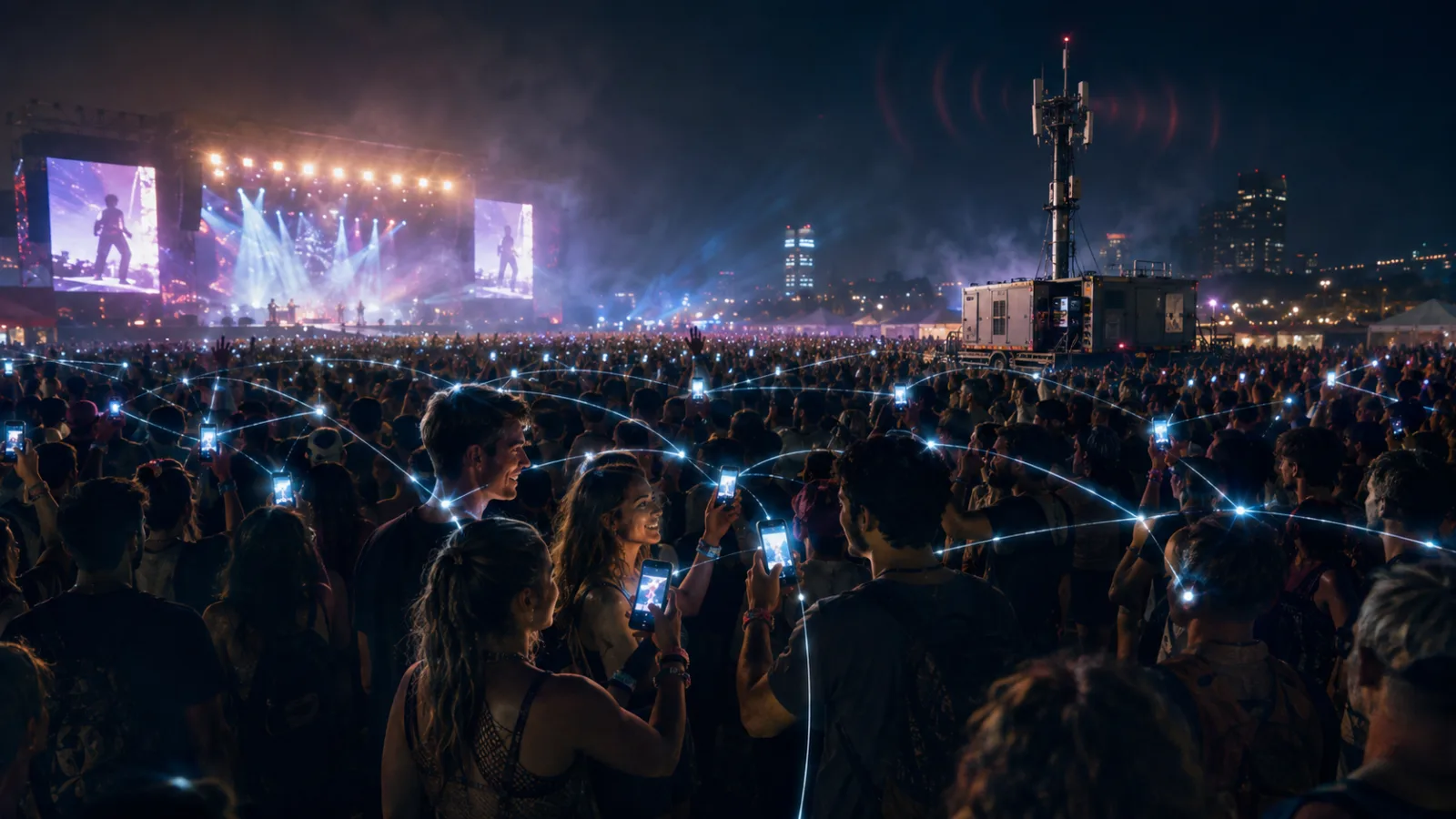
Somewhere around 10:58PM, the headliner walks on. Eighty thousand people lift their phones at the same moment. And the most impressive temporary network ever built for a field in the middle of nowhere quietly falls over.
This is a story about that minute — and about what still works after it.
First, the engineering nobody sees
Event connectivity is genuinely remarkable, and it deserves more credit than it gets. Ever wondered how thousands of people get a signal at a farm with no permanent infrastructure? The answer is usually a Cell-on-Wheels: a portable cellular base station on a truck or trailer, carrying everything a permanent tower has — antennas, radios, transmitters, backhaul.
Telescoping masts lift antennas high above the crowd for line of sight across the whole site. Generators run them for days without touching the grid. Multiple frequency bands mean one unit can serve every carrier on the field at once. Microwave or fibre backhaul hauls all that traffic back to the real network.
For a multi-day festival, organisers often ring the site with several of them, overlapping the coverage so there are no holes. It is a serious piece of temporary infrastructure, deployed by people who are very good at this.
And it still folds
Here is the thing about a crowd: it does not use the network evenly. It uses it all at once.
The encore starts and everyone records. The set ends and everyone texts. The headliner walks on and eighty thousand people reach for the same tower in the same ten seconds. Capacity planned around average load meets a demand curve shaped like a cliff, and the result is the thing you already know from experience — full bars, nothing sending. Messages queue. The map freezes on where your friends were four minutes ago. “Where are you?” bounces back unsent.
No amount of temporary infrastructure fully solves this, because the problem isn’t coverage. It’s simultaneity.
Use the radios already nearby
This is the gap FindTribe was built for.
Nearby participating FindTribe phones can relay your encrypted location updates and DMs one Bluetooth link at a time. The phones in the middle cannot read the packet or identify it as yours.
If there is no complete route yet, a participating phone may hold the sealed message and forward it when a usable path appears.
Bluetooth Low Energy is designed for low-power communication, though actual battery use varies by device, location settings, screen time and conditions. More participating phones may create more possible relay paths, but delivery still depends on distance, movement and a continuous route.
What to actually do before you walk in
Five minutes of preparation is the difference between a good night and a long one.
Let the map download
Activate the event while you still have signal and the venue map lands on your phone — stages, gates, water, restrooms. Your schedule and your meet points come with it. Offline features require Bluetooth to remain enabled; if airplane mode turns Bluetooth off, switch it back on.
Agree on a meet point
Drop one before you split up. Everyone in your tribe gets a bearing, a distance and a route to it — and the pin doesn’t need a signal to keep pointing.
Know where SOS goes
If something goes wrong, FindTribe alerts the trusted people you selected over internet and Bluetooth at the same time. It does not contact venue staff or emergency responders, so call local emergency services whenever you can.
Mark the car
Drop a pin on the way in and tell FindTribe that’s your car. At 1AM in a field full of identical cars, this is the best thirty seconds you will ever spend.
The point
Event connectivity keeps getting better, and that is genuinely good news. Drone-mounted cells are being trialled. Networks are getting smarter about predicting where load will land.
But the moment you actually care about — the one where you are separated from your people, at night, in a crowd of eighty thousand — is precisely the moment the towers are under the most strain. Planning for that moment is not pessimism. It is just knowing how crowds work.
Your plan for finding each other should not depend on one overloaded tower.